Sun Ra Supporters Experience…the Impossible
Documentary about Sun Ra makes Chicago premieres at Kennedy-King College
Pre-flight preparations…
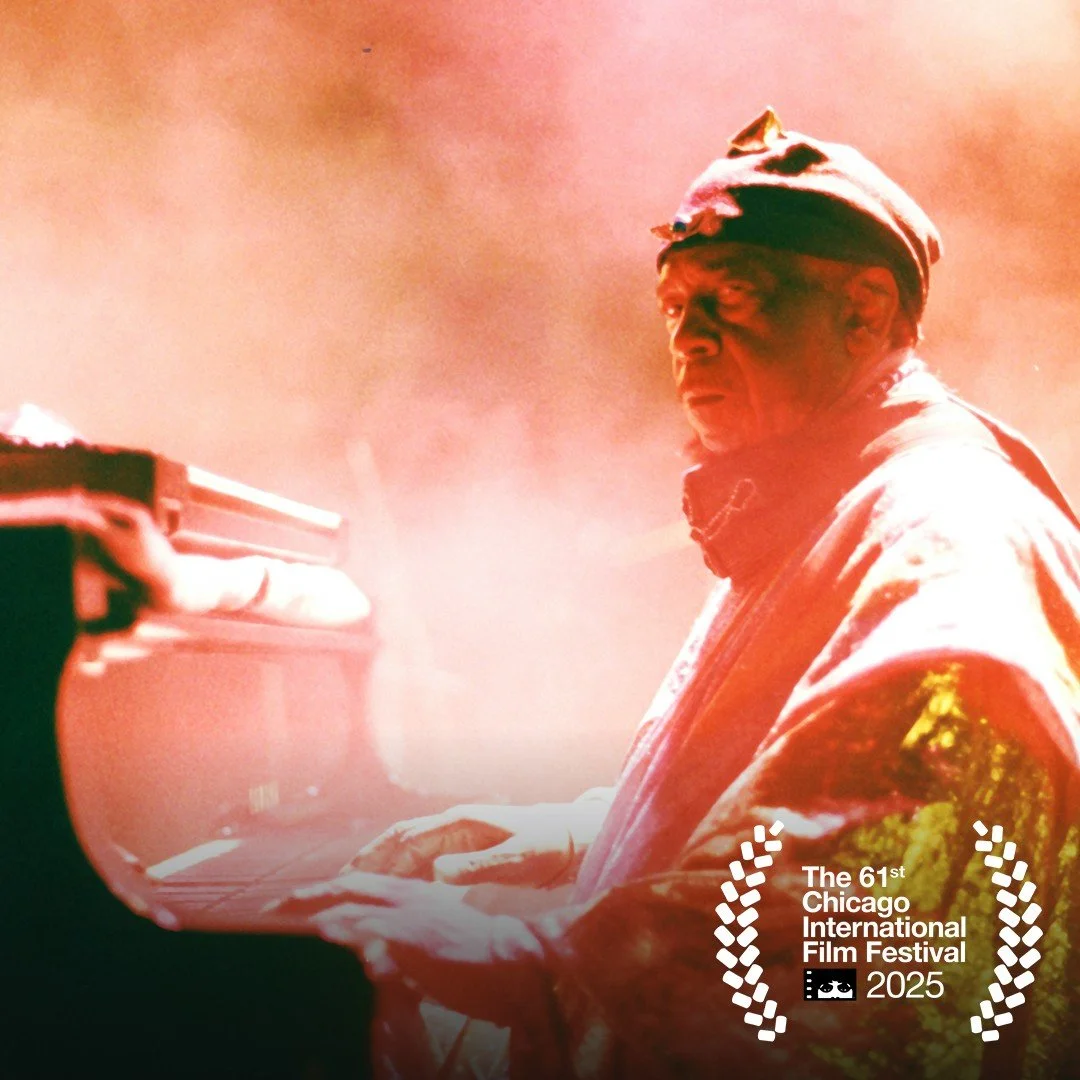
Everyday people became extraordinary passengers as they entered the theater. They were gathered there that evening to journey through the music, methods, and messages lived without compromise by keyboardist, composer, bandleader, poet, and Egyptologist Sun Ra (1914-1993), best known for creating sounds and science, through and in space, from Earth to Saturn…and then back again.
Every passenger boarding this 291-seat venue – let’s call it a spaceship! – had one mission in mind: to witness Sun Ra: Do the Impossible. This documentary premiered in Chicago on October 24, 2025, at Kennedy-King College’s (KKC) Theater, 740 West 63rd Street. Directed by Christine Turner, the screening represented a collaboration between KKC’s Center of Equity for Creative Arts (CECA) and the Chicago International Film Festival (CIFF).
While boarding, passengers were welcomed with sounds from Ra’s discography that flowed through the spaceship’s sound deck. This sonic serenade included “Hour of Parting,” from the album Jazz in Silhouette, recorded in 1958 at El Saturn Studio in Chicago.
Additional explorations happened through “Enlightenment,” which included the following declaration: “The fiery truth of Enlightenment/Vibrations come from the Space World/Is of the Cosmic Starry Dimension/Enlightenment is my Tomorrow/It has no place of Sorrow/Hereby, our Invitation/We do invite you to be of our Space World.”
Further inspiration followed when four singers from Chicago’s West side, the Cosmic Rays, joined Ra on “Drowning,” from Space Age Rhythm & Bop (The 1950s). A portion goes like this: “Dreaming, dreaming/Here I am dreaming again/Dreaming/dreaming/I’m in a deep dream again/Sleeping, sleeping/It’s time for me to wake up.”
An Abstract about the Ultimate Abstractionist
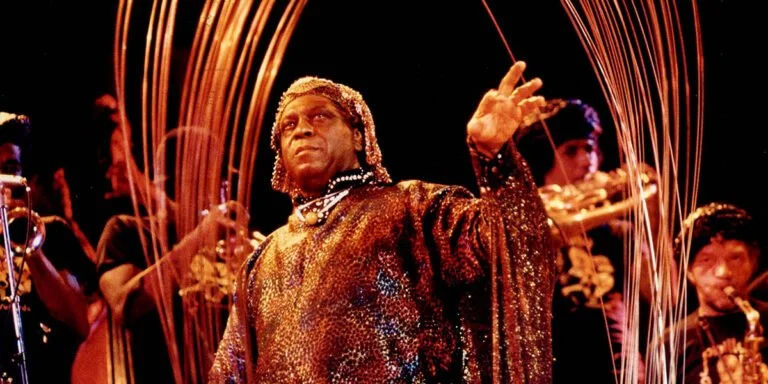
From his birthplace in Birmingham, Alabama, Herman Blount relocated to Chicago in 1945, where he played piano in ensembles led by saxophonist Gene Ammons, singer Billie Holiday, and big band leader Fletcher Henderson. In the 1950s, Blount started composing his own music and assembled his own ensemble. Then, on October 20, 1952, Blount would adopt a new name and persona, Le Sony’r Ra, later shortened to Sun Ra, with the surname being Ancient Egypt’s Sun God.
This new identity originated from Ra’s belief that he had had an experience that took him (mentally/spiritually) to Saturn. There, he received orders to quit music studies at a local state college in Alabama. Upon forming his ensemble, the Solar Arkestra, in the early 1950s, Ra chose Arkestra, not orchestra, he said, because Black people pronounced it that way. He further explored his fascination with Science fiction, outer space, and Black nationalism, through his music, poetry, and lectures. (It has been estimated by researchers that Ra wrote more than 1,000 compositions and recorded more than 100 albums on El Saturn Records, his own label, assisted by Alton Abraham, his business partner.) Abraham, an x-ray technician and entrepreneur, graduated from Woodrow Wilson Junior College in 1950. That institution is now known as Kennedy-King College.
Attending the Flight
After Alisa Inez McLaughlin and Dr. Enid Wells – CECA’s executive director and co-founder, respectively – welcomed everybody, Sekou Conde, executive director, Muntu Dance Theater, summoned positive spirits by performing a solo on the djembe. This instrument, Baba Sekou explained in a correspondence with this publication, is “a Drum originating from the Malinke people of West Africa.”
And then…the Impossible began…
…with Ra playing “Over the Rainbow.” This standard, composed by Arlen and Harburg, appeared on numerous Arkestra recordings.
Beyond his prolific musicianship, Do the Impossible also explored Ra’s poetry. One particular poem he read proclaimed: “Imagination is a magic carpet/upon which we may soar/to distant land and climes/and even go beyond the moon/to any planet in the sky/if we came from nowhere here/why can’t we go somewhere there?”
Do the Impossible also gets into “The Black Man in the Cosmos,” a course Ra taught at the University of California-Berkeley in 1971. Among the two-dozen-plus readings assigned by Professor Ra were books by Henry Dumas, Yosef A.A. ben-Jochannan, and Frederick Bodmer. (When discussing Ra’s voracious reading appetite during the post-screening question/answer session, Turner noted that Ra and Abraham read an estimated 10,000 books.)
During one lecture, found on openculture.com, Ra, when discussing God’s wrath on wrongdoers, stated, “God told a man… ‘Go out and you show them what I’m going to do to them, if they don’t do what I tell them to do….So go out and take some man’s manure and bake it. And get in front of the folks and eat it.’ That’s in your Good Book, but it didn’t say that at first,” he said, noting that this story had been altered.
“I have so many names. Some call me Mr. Ra. Others call me Mr. Re. You can call me Mr. Mystery.” – Sun Ra
Among the many artists and scholars appearing in this documentary were novelist Ishmael Reed and saxophonist Marshall Allen, who joined the Arkestra in 1958. Allen, who celebrated his centennial in 2024, has led the Arkestra since 1995. He also earned National Endowment for the Arts (NEA) Jazz Masters recognition in 2025, the same year he released his first album. (Ra received the same honor in 1982.)
Allen first heard the Arkestra in 1957. He recalled being very impressed with the ensemble’s beauty. “It was different…from what I (had ever) heard, so I wanted to be a part of it,” Allen said in a video posted by the NEA. When Allen auditioned for the Arkestra, he showed up expecting to see charts to play from but saw none. His assignment from the leader: play whatever he felt in the moment.
Reed, an Oakland, California-based writer, has published numerous novels, plays, librettos, and poetry. One Reed poem, “I Am a Cowboy in the Boat of Ra,” includes this here boast: “I am a cowboy in the boat of Ra. I bedded down with Isis, Lady of the Boogaloo, dove down deep in her horny, stuck up her Wells-Far-ago in darling midday getaway.”
Also in the documentary, poet/dancer Harmony Holiday discussed Ra’s absolute fearlessness. “It (took) a lot, as a Black man, to do all the things he did with so much sovereignty, with no examples of anyone like him…”
Music journalist Marcus J. Moore called Ra “a pioneer in Afrofuturism,” a term invented by critic Mark Dery in 1994. Afrofuturism envisions a new reality for Black people through a Black perspective.
“(Sun Ra) influenced mainstream cats…underground cats, everybody,” Moore said. “His influence is just that vast. He was making music for the future.”
This term, however, bothered Chicago-based saxophonist David Boykin, who also attended the screening. Ra, Boykin noted during a recent conversation, never considered himself an Afrofuturist, as the term Afrofuturism first appeared one year after his death.
“To posthumously go back and say that a person was an Afrofuturist…is a way to boost your frame of importance about Afrofuturism,” said Boykin, who recorded and posted 20 Ra poems to his bandcamp.com page in 2020. (Also, on May 22, 2014, on what would have been Ra’s centennial, Boykin and two dozen other saxophonists improvised a 30-minute blowing session in Washington Park to honor him.) “You don’t even say if they are allowed to say they would be Afrofuturists. You just say they were. It’s a marketing thing.”
Post-flight Q&A
After the cinematic journey ended, passengers listened as Joyy Norris, CIFF’s Black Perspectives Programmer, and Turner discussed the experience. When recalling her introduction to Ra, Turner talked about hearing Yo La Tengo, an indie rock band, covering “Nuclear War,” the title track from Ra’s 1982 album. A portion from this song states: “They talkin’ about (Yeah)/Nuclear war (yeah)/They’re talkin’ about (yeah)/Nuclear war (yeah)/If they push that button…Your ass gotta go.”
A few years after this exposure, which happened in the early 2000s, Turner watched the 1974 film Space is the Place. This film, co-written and starring Ra, represented an extension of his lectures given at UC-Berkeley. Through this film, Turner began to understand his cultural significance.
Do the Impossible, she added, attempted to add onto what other researchers had already discovered. She also wanted to validate his legitimacy as an innovator.
“One thing I picked up on when reading his obituaries, and a lot of writing done at the time he was alive…was how he had not been accepted by the mainstream jazz establishment,” she said. “He was really dismissed and oftentimes described as this kooky, unserious person. We really wanted to take him seriously.”
Turner’s investigation into Ra’s philosophy included listening to his lectures, especially “The Alter Destiny.” This concept originated from Ra’s belief that his music did not belong to the past, present, or future.
“I’m really striving to do something about humanity,” he began, “(about) the feeling that I would have to reject everything this planet has done so far as useless, because it hasn’t accomplished anything.”
Even though absorbing Ra’s philosophies proved to be more than challenging, Turner eventually appreciated his purpose and mission.
“For many people, there is a conversation between the idea of Alter Destiny…and what a lot of people are talking about now: Afrofuturism,” she said. “They’re not one-to-one corresponding, but there are lots of threads there. A lot of the ideas he talked about in terms of the future…are things people are talking about right now in terms of imagining alternate Black futures.”
When Norris asked about how music and archival footage were selected, Turner noted Ra’s massive, decades-long production, and how Arkestra recordings and rehearsals are still being discovered today. “So you’re always playing catch-up,” she said. (At the most recent Grammy Awards, Ra’s Lights On a Satellite, a live album recorded in 1978 and made available last year, received a nomination in the Best Large Jazz Ensemble Album category. It lost out to Without Further Ado, Volume One, by the Christian McBride Big Band.)
More material, such as performance footage, photographs, and Ra’s self-published poetry, were located by Turner at the University of Chicago, the Experimental Sound Studio, located in Edgewater, and Northwestern University. A huge find, she added, involved footage documenting Ra’s 1971 journey to Egypt.
“There had been bits and pieces around, but (my team and I) were able to track down a print. We were incredibly fortunate that there is visual footage to include,” she said. “There wasn’t as much to include from Birmingham as we would have liked…but I think the film also plays with time a little bit. Sun Ra did not think or work in a linear fashion, so the film also takes liberties as to how it’s constructed and the way we use music to tell the story.”
Ra’s experimental nature, she added, led her to venture into the unknown. One such adventure took her to “The Shadow World,” included on Wake Up Angels, a live album recorded in 1974. Ra, she noted, described this as his most “out there” song. “But,” Turner said, “there was an incredible segment we weren’t able to include around that song.”
Turner’s investigations also led her to Amiri Baraka and the Black Arts Movement of the 1960s. Baraka (1934-2014), a revered playwright, poet, and social activist, performed his play, A Black Mass, with Ra’s ensemble in 1968. He also composed “Words From Sun Ra,” published in his book, Razor. Here’s a taste for ya: “You on the Space Ship Earth/& you outward bound/destination unknown/But you haven’t met the Captain/Of the space ship yet!”
When Norris asked how building Do the Impossible impacted her creatively, Turner replied that her reception to new ideas, especially with editing, happened. She also noted how Ra’s uncompromising will to maintain his Arkestra for more than four decades impressed her greatly, especially the way his life served as an example to his players.
“He really believed in discipline and precision,” she said. “He talked repeatedly to his musicians about that, and that’s something he imbued in me and my team.”
When discussing what he learned from Ra’s work ethic, Allen told theguardian.com, “It took quite a few years to see what he was talking about, so that’s how I learned – the hard way, and work, work, work. A man cannot learn without discipline. All he needed was your time.”
Explaining, then Deplaning…
Before everyone disembarked from the spaceship, passenger Jocelyn Turner (no relation to Christine) asked if Ra had any romantic relationships, to which the director stated, “He was dedicated to his music, first and foremost. Even the people closest to him did not observe him in any relationships.”
Jocelyn also asked, “Did he have mental health challenges?”
Christine diagnosed Ra as a highly functioning, creative artist. She did not believe him to be schizophrenic at all, nor did this issue really matter to her.
“I think this film is really touching on the idea that he was this powerful resource, not just for Black people but for all people,” she said. “I thought his ideas around mythology and mythmaking were important to investigate, rather than questions about his mental health, and questions about his sanity, which I don’t think can really ever be answered.”