Platinum Jubilee! Hamid Drake Celebrates 70 Years of Life in the Creative Lane
Drummer discusses his life, then plays like his life depends on it, at Hyde Park Jazz Festival and Constellation
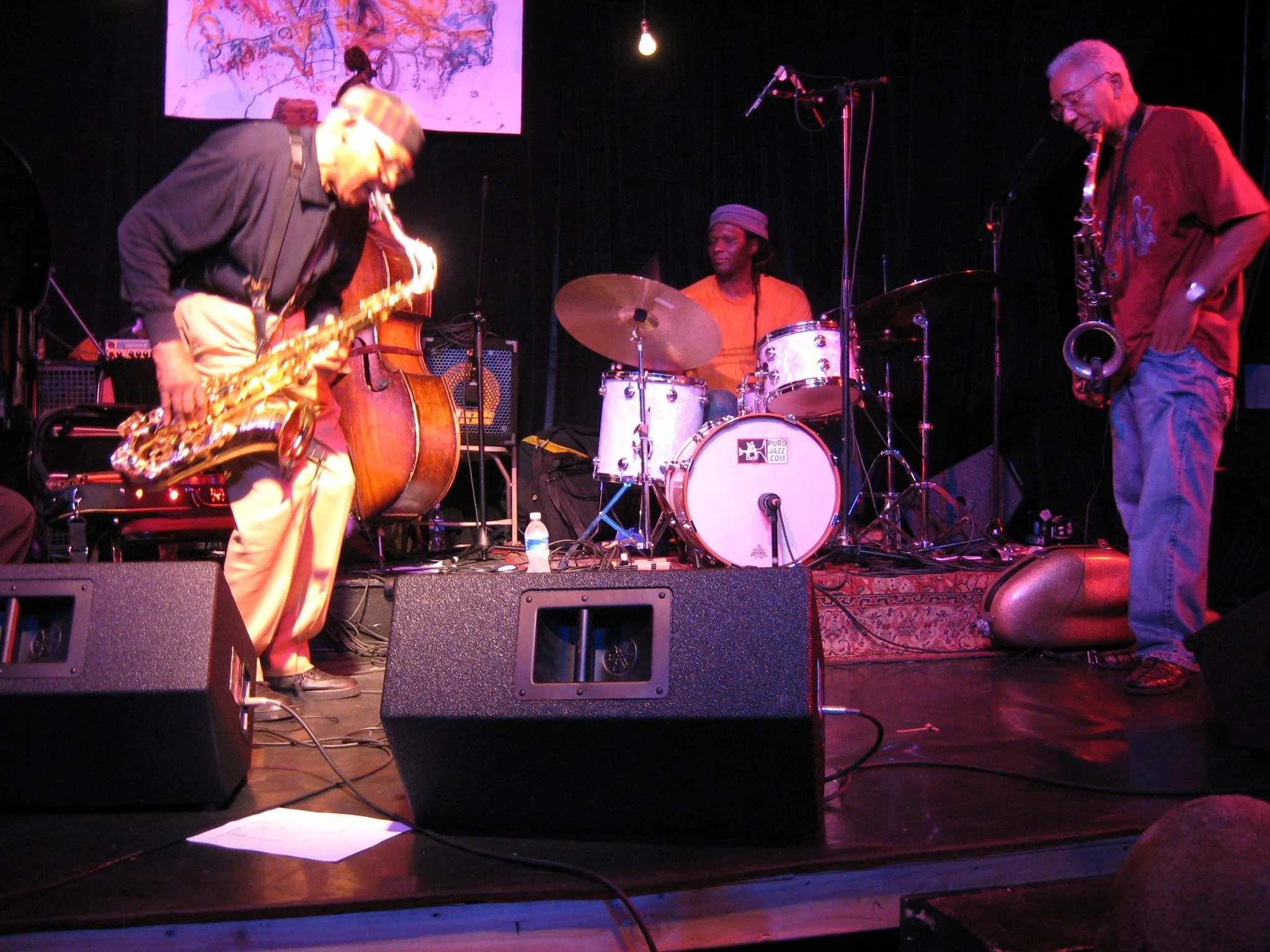
Anderson and Drake, with Kidd Jordan (right). Photo by Lyn Horton.
Fifty-five years after defeating death the first time, the septuagenarian remembered every detail.
He had been playing drums by himself in his family’s basement and decided to take a break. Stretched out on a carpet, he welcomed the moment, until…he heard a sound.
Then, something/some…thing (?) made any physical movement impossible. His eyes, now shut, stayed that way against his will, but a bright light appeared in his mind’s eyes.
When another energy invaded his being, starting at his feet and forcing its way to his throat, fear threatened to consume him whole.
“I became even more afraid,” he said, “because I had a realization that whatever this is – all this tingling and sparkling and all kinds of stuff happening – if it gets up here (in my head) I’m gonna die…
“And then it stopped.”
This experience, as told by Hamid Drake, comprised multiple moments he shared during an hour-long discussion with Michael Zerang, fellow percussionist and Winter Solstice performing partner for the past 35 years.
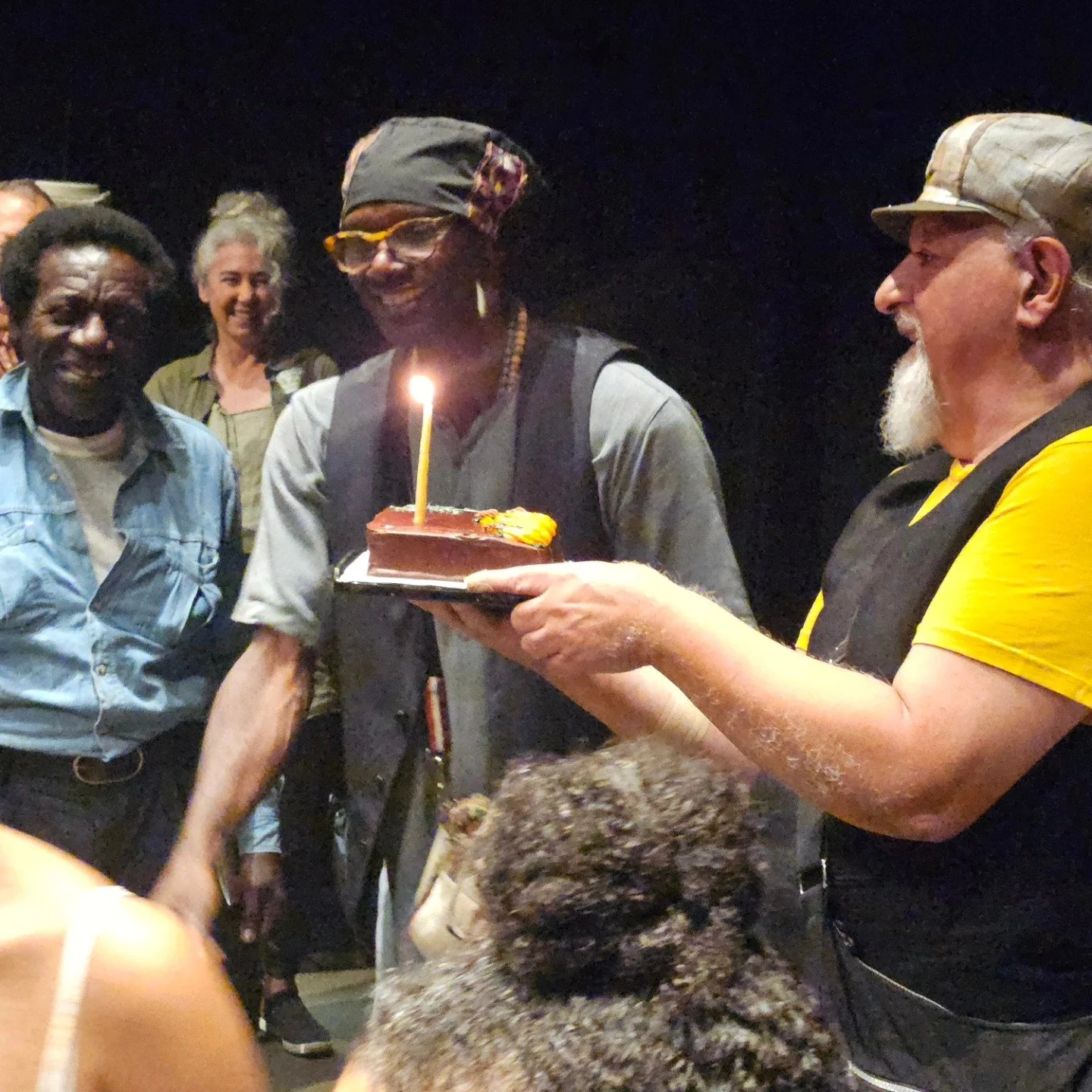
Held on September 27th during the Hyde Park Jazz Festival (HPJF), this occasion celebrated Drake’s 70th birthday. It followed a performance by his quartet, which included tenor saxophonist/pianist Ari Brown, vibraphonist Jason Adasiewicz, and bassist Joshua Abrams. Both events happened at the Logan Center, located at the University of Chicago.
Drake, whose career began in the early ‘70s, has earned acclaim for his free-form drumming through performances in Africa, Moscow, Portugal, and the former Velvet Lounge, located on Chicago’s South side. He has also expressed his artistry through the frame drum and tabla. His mammoth recording credentials include Pete Brotzman, Herbie Hancock, the Natural Information Society, Malachi Thompson, and tons more.
Since 1990, Drake and Zerang have performed Winter Solstice concerts. These sunrise sessions that welcome the season are held at Constellation, 3111 North Western Avenue. The most recent sessions were held December 21-23. There were also two evening sessions held December 21 and 22, where various ensembles celebrated Drake’s seventh decade.
“It’s the privilege of my life, and I don’t say that lightly,” Zerang said to Drake, “to work with you on the Winter Solstice and other projects…for all these years.”
What Started After the Attack Stopped
Drake’s search for and immersion in spirituality began after he defeated death. His investigations led to books about yoga, where he discovered a term, kundalini. He described it as, “energetic experiences that happen in the body, and usually it happens when people are doing certain spiritual practices, maybe breathing exercises or reciting mantras. But the only thing I was doing was playing drums,” he said, laughing. Then, on August 3, 1971, his 16th birthday, Drake accepted the Baha’i faith.
“It was the first time I had heard that all religions are one, or that mankind is one, that there is equality of men and women,” he recalled. “All these teachings were coming into me.”
“The music seems to be the way you expressed this,” Zerang said.
“The music is truly one of those ways,” Drake replied.
Given Away in Love
Drake’s mother birthed five children; her sister, however, could not birth children, so Ms. Drake allowed her sister to raise Hamid, (then known as Hank), her youngest child.
“To me, that’s a humongous sacrifice. It shows the type of love that was there. I was given in love and raised in that way,” said Drake, who also noted that the sisters died two days apart.
At age seven, Drake’s family lived with the Anderson family in Evanston. (They had relocated from Monroe, Louisiana, Drake’s birthplace.) He watched in wonderment as Fred Anderson, the patriarch, would return home from his hotel gig, go directly to the basement, and play his saxophone. This devotion to discipline and expression impressed the child.
While attending Saint Paul African Methodist Episcopal Church, the preteen played bongos. In elementary school, he wanted to play trombone in the stage band, but since there were no more ‘bones left, the band director told him to play a snare drum and bass drum instead.
And this pissed Hank off!
“I didn’t want to be banging on a bass drum and playing the snare drum with another geeky kid!” Drake said.
His apathy continued into drum lessons. Even the teacher sensed Drake’s displeasure, but then…
“One day, he wrote out this basic rock ‘n roll pattern and played it for me,” Drake recalled. “When he did that, I was like…Wow! Man! And he looked at me, like, ‘Gotcha!’”
Becoming a Professional, Man!
As he approached and then entered adulthood, Drake’s basic desires were to look cool while playing drums. He played in an R&B garage band while digging music by James Brown, Mahalia Jackson, and Wilson Pickett.
One night, while a jazz-rock ensemble he played in completed their warm-up set at a local club, Anderson began setting up for his trio, which included drummer Steve McCall and bassist/trombonist Lester Lashley. Anderson mentioned that he planned to start a new ensemble and asked Drake if he wanted to join. Drake said yes. This ensemble included trombonist George Lewis, saxophonist/instrument inventor Douglas Ewart, and artist/dancer Tsehaye Hebert, among others.
“That’s when I realized this is what I want to do. This is how I want to express my creative life,” Drake recalled. “To me, Fred was the Grand Baba. He was the one that totally introduced me to improvising, because I had no idea what to do.”
Yeah, Drake could play the tunes’ themes, no problema, but…what to do after that? While the Logan Center Screening Room audience listened, Drake revealed Baba Fred’s advice.
“He didn’t give me a straight answer. He said, ‘Ah, Hamid, I see that you like to approach the drums in a melodic way, so I want you to listen to Ed Blackwell,’ ” Drake said, referencing the drummer in saxophonist Ornette Coleman’s quartet. “And so I did.
“Fred Anderson was an indicator of signs,” he continued. “He had a way of saying a certain thing, and then pointing you in the direction that he felt you should go, that he knew you should go, even though you didn’t know you should go in that direction. He guided me…and I finally got a sense about what this whole thing was about.”
(Together, Anderson and Drake released more than a dozen recordings, including Dark Day, with trumpeter Billy Brimfield, in 1979; Destiny, with pianist Marilyn Crispell, in 1995; and Timeless, Live at the Velvet Lounge, with bassist Harrison Bankhead, in 2006.)
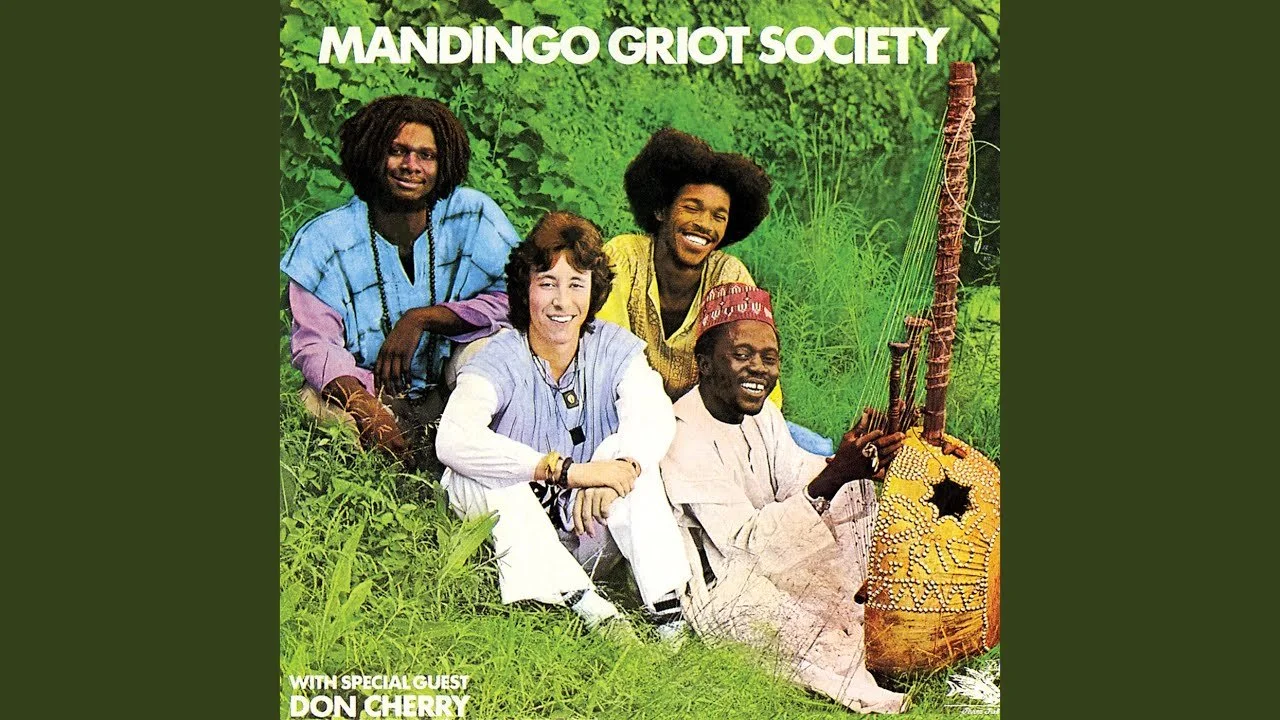
As Drake’s investigations into yoga deepened, so did his curiosity about African and Indian cultures. While wandering through a drum store, he responded to an ad from a tabla instructor and began taking lessons. He would also take conga lessons at another drum shop. While there, he met another student, Adam Rudolph. The two would eventually play in the Mandingo Griot Society, an ensemble that also included bassist Joe Thomas and the founder, Foday Musa Suso, a Gambian who played a string instrument from west Africa called the kora.
This ensemble recorded in the late ‘70s and early ‘80s. For their self-titled debut recording, trumpeter Don Cherry appeared as the special guest. Then, after the sessions ended, Cherry invited Drake to spend time with him and his family at his home in Sweden.
“(Cherry) is known as ‘The Father of World Music.’ He didn’t call himself that, but everyone else did,” Drake said, adding that Cherry preferred the term folk music, or the music of folks, instead. “He was an exemplar on the importance of moving beyond your cultural boundaries and having a love and passion for other types of art throughout the world.
“He was a genius in bringing different people from different cultures together and making music,” Drake continued. “And Don would always say, ‘You are me, and I am you.’ ”
When asked by Zerang when and how his visibility exploded, Drake cited his involvement with Comin’ and Goin’, an album released in 1983 by saxophonist Jim Pepper. This album featured Pepper chanting and singing “Witchitai-To,” which, Drake noted, has its origins in Native American culture. Pepper’s parents were Native Americans, with his mother and father being of Kaw and Cree origins, respectively.
“This is a song about the journey that one takes in the native, traditional struggle with people and going to the spirit world,” said Drake, who then repeated the song’s signature affirmation:
“Water spirit feelin’
Springin’ ‘round my head
Makes me feel glad
That I’m not dead.”
Drake versus Death: Round Two
In 1985, Drake joined Cherry and Pepper on a tour of west Africa co-sponsored by the U.S. State Department. The group visited Manaco, a village located in Mali. Drake, having been inspired by Roots, Alex Haley’s epic family biography, and books about the Mali empire, looked forward to the journey.
When checking in to the hotel, a front desk clerk advised Drake to avoid opening the screen to the balcony. Well, while checking out Drake’s room, Cherry opened the screen, noticed the gorgeous scenery, and left the screen open.
W i d e open.
A mosquito entered the room, found Drake, and then – without introduction or consent – dined on his flesh.
“When I woke up, my lip felt really funny,” he recalled, about the first symptoms of malaria. “I was feeling my lip (which had enlarged.) But I traced the mosquito down, and I found it.” Drake exacted revenge on the creature in his own way. (Here’s hoping folks from the “People for the Ethical Treatment of Animals Only” don’t find out!)
Eventually, the tour continued to other countries. The ensemble played for prime ministers and artists from Senegal, the Ivory Coast, and Sierra Leone. But even when temperatures were hellishly hot, Drake’s condition made him feel as if it were winter in Chicago.
“I felt like I was gonna die,” he said.
Still, even with these obstacles, Drake received a spiritual infusion that resonates to this very day.
“Going to the Continent, I realized that everything I had been told was a lie. I had the opportunity to go there and see,” he said. “My brothers and sisters there didn’t treat me like I was an oddity. They were like, ‘Brother, welcome back home! Welcome back! You’re home now!’ ”
Intermission (Take a brief break…)
That’s enough. Welcome back!
Set Two
Participants as announced from the stage: Ginger Mance, Tsehaye Hebert, Darren Nealis, Andy Pierce, Zahra Glenda Baker…and a special guest.
Times and Places: The Logan Center, September 27, and Constellation, December 21-23.
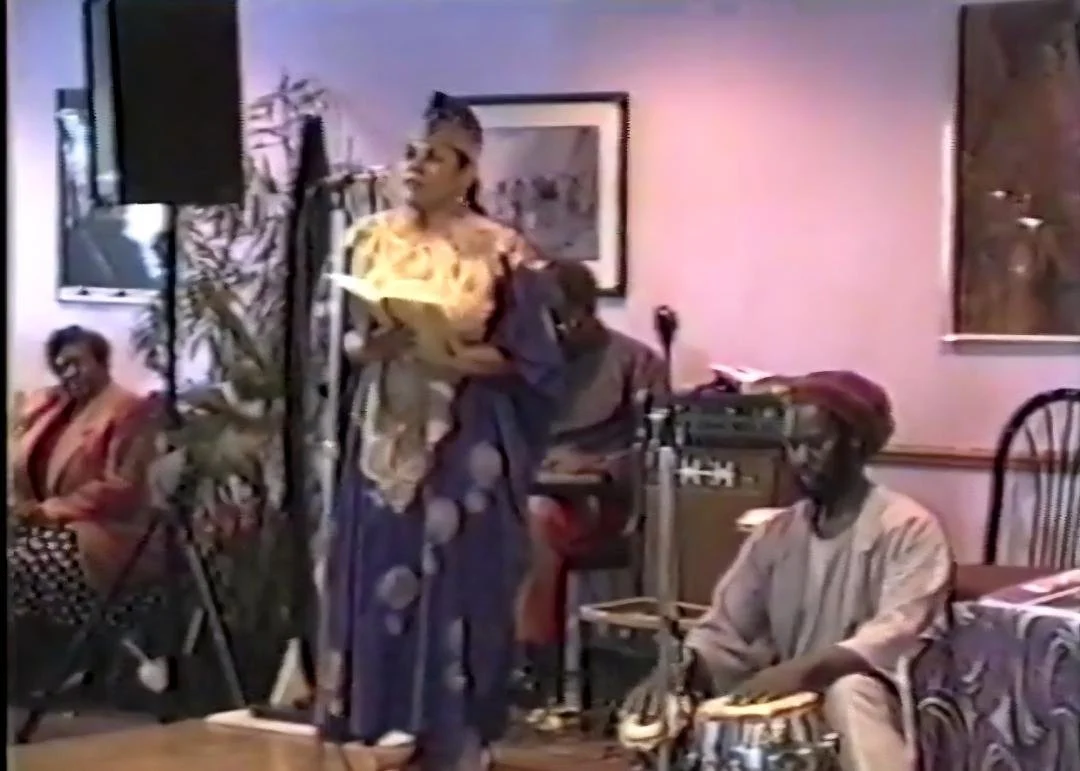
Once the Drake/Zerang discussion ended, a reunion happened when Ginger Mance approached the stage and reintroduced herself to the Dude of the Hour. Mance, an attorney and poet, had not seen Drake since 1994, when he performed with her at a reading and performance for her first book, An Ancient Fire Burns. Drake’s willingness to listen and accompany Mance’s words proved memorable for her.
“Hamid’s submissions to being channeled by a higher source allowed the divine to perform through him,” said Mance, who likened his percussion acumen to Mahalia Jackson’s vocal agility. “It’s clear that he practices his evolution of spiritual growth, especially in the way he listens deeply to whoever he’s working with. He’s a great listener and observer with an awesome spirit.”
Tsehaye Hebert, whose husband, guitarist Abdul Hakeem, played with the Mandingo Griot Society, also attended the dialogue. Hebert, who met Drake before his 20th birthday, recalled his amazing maturity at such an early age. She recalled how his playing complemented musicians in Anderson’s ensemble who were twice his age.
“Hamid brings lots of artistic integrity to whatever project he’s working on,” she said. “He never brings arrogance. He always brings discovery and his whole self.”
Darren Nealis, a native Chicagoan now living in Olympia, Washington, attended the Solstice and evening performances. Drake’s trademark sound, which Nealis has enjoyed since the early 1990s, always inspires him.
“When you hear Hamid live on recordings,” Nealis said, “you can instantly tell who is playing the drums, which is not an easy feat for a drummer.”
The most recent Solstice, Nealis added, retained its beauty through unified communication.
“Hearing Hamid and Michael Zerang improvise with their hand drums via candlelight, before transitioning to joyous and furious rhythms on their drum kits, as the sun comes up and fills the room with light, is such a profound experience,” he stated. “There is nothing else like it.”
Andy Pierce, Anderson’s assistant at the Velvet Lounge, drove Drake to the Solstice performances. He also expressed gratitude about what he experienced.
“The whole thing about entering the Solstice is that it’s quiet, dark, and then the music unfolds,” said Pierce, who plays recordings by Anderson and Drake on Another Place, a weekly show he hosts on WDCB-FM. “Then the music unfolds, and we all take that ride, that arc. It’s…just…beautiful!”
Zahra Glenda Baker sang with an ensemble that began the evening’s performances on December 22. (Various ensembles performed both nights, including Zerang’s quartet. Additional performers joining Drake included Tatsu Aoki, shamisen, trombonist Jeb Bishop, sitarist Shanta Nurullah, bassist Kent Kessler, and dancer Anaya Wolfe, Drake’s granddaughter.) Baker noted how Drake encourages everyone to bring their entire beings when expressing themselves.
Before the collective group improvisation began, Baker’s purpose and goals, as encouraged by the honoree, were to perform an invocation, where everyone present would be invited to a place made sacred through the performers’ in-the-moment, unrehearsed artistry.
“It was an interesting moment of stillness, which was great. It was, let’s just be still together, first,” she recalled. “And then I started humming, and slowly, it became a conversation. We were in response, not only to each other, but to everything, to being aware, that this audience was witnessing this experience of being creative together.”
As this invocation progressed, Baker invited everyone to sing. She then looked directly into the audience to make her intentions clear.
“I wanted to call attention to the idea that it wasn’t a performance where it was just us on stage and them watching,” she explained. “Whether they were singing or not, the energy that was happening happened because they were in that room also.”
And now…returning to the stage for an encore: Hamid Drake!
Let’s conclude with his first comments to the HPJF audience about how everything in his career has happened due to folks like Anderson, Hebert, and HotHouse Founder Marguerite Horberg, who all nurtured him.
“Chicago,” he said, “is the place that gave me the fertilizer and courage to create and continue.”