2 Brown Sisters and Hundreds More “HIPsters” Honor Oscar Brown Jr.’s Century of Excellence
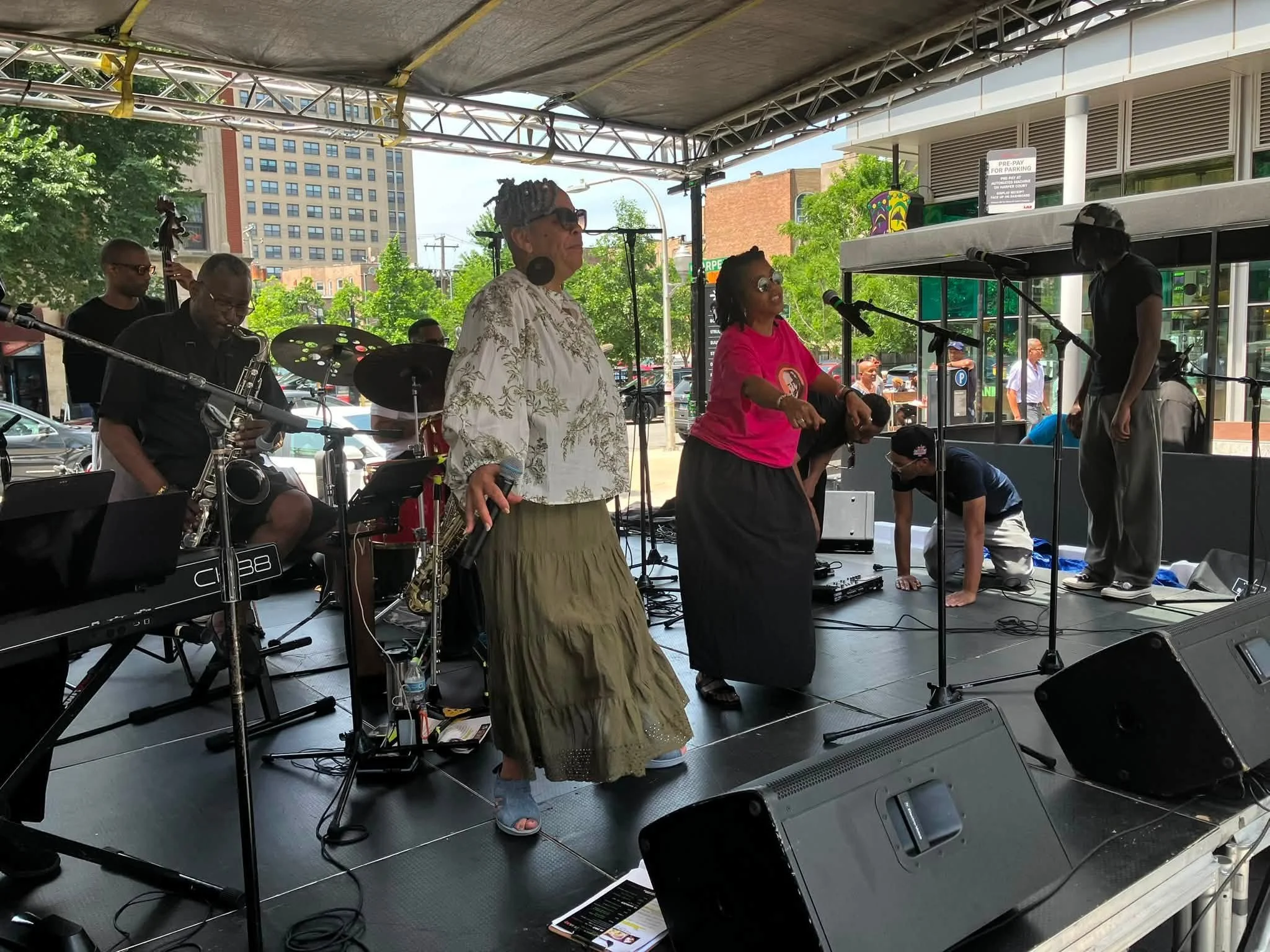
Maggie and Africa. Photo: Reginald Avent
Square folks – for whom no room has been allocated here – call it multiple choice. But in this joint, where the vernacular of the hip, invented by the late jazz radio host Larry Smith, is spoken, it is called Polygamy of the Mind.
Question: What is hip?
A…A slammin’ track by the bold, brass brothers from Tower of Power.
B….An acronym that means Human Improvement Potential, promoted by poet, singer, playwright, and activist Oscar Brown Jr. (1926-2005).
C…Both. And at the same time!
If you answered C, your two-timing mind is correct. It really is okay to get caught…this time.
This Just In!
Hip has earned a promotion, as wingtip shoes with Cuban heels have been placed on the “i” and “p,” so it is now really HIP. The question from before will now be repeated as “What is HIP?” and reborn as a question/essay title asked and answered by Brown.
“Any ideas or activities that advance the interests of humanity have a HIP quality. Obviously, that which impacts negatively on the human condition has none,” Brown wrote. “Being hip means being aware of whom and where you are. Being hip requires sufficient information to deal with the circumstances. Being hip involves making positive moves in healthy directions. Being hip appreciates our close kinship with others of our kind” (oscarbrownjr.org).
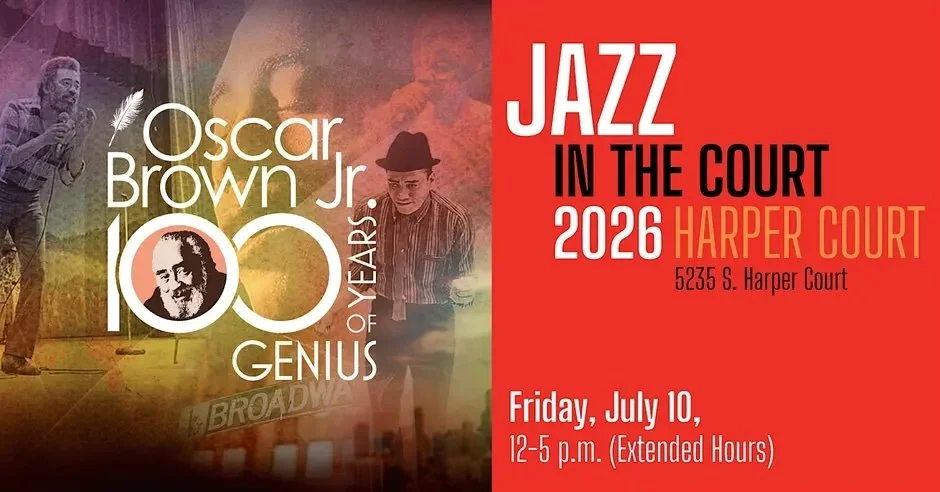
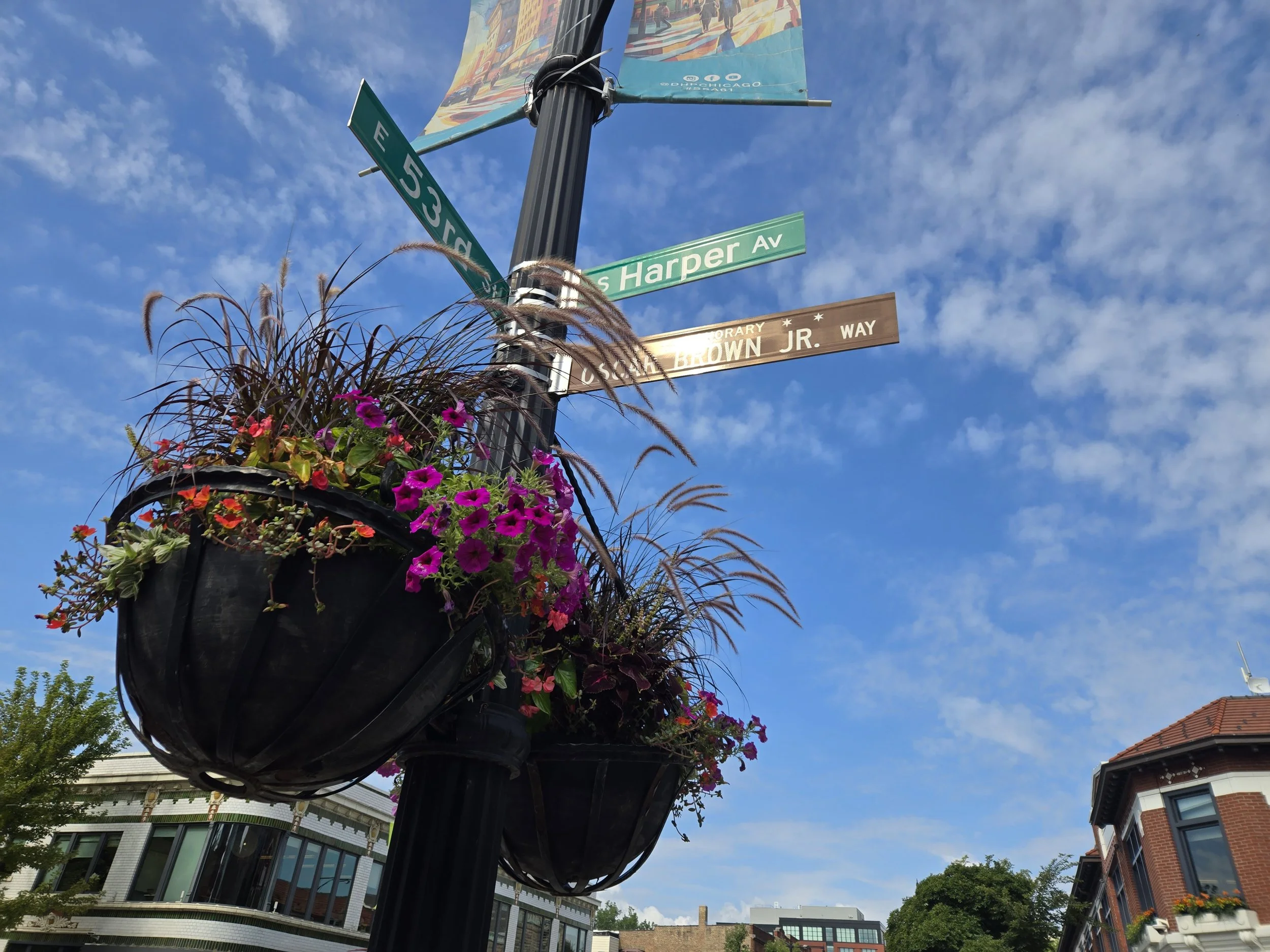
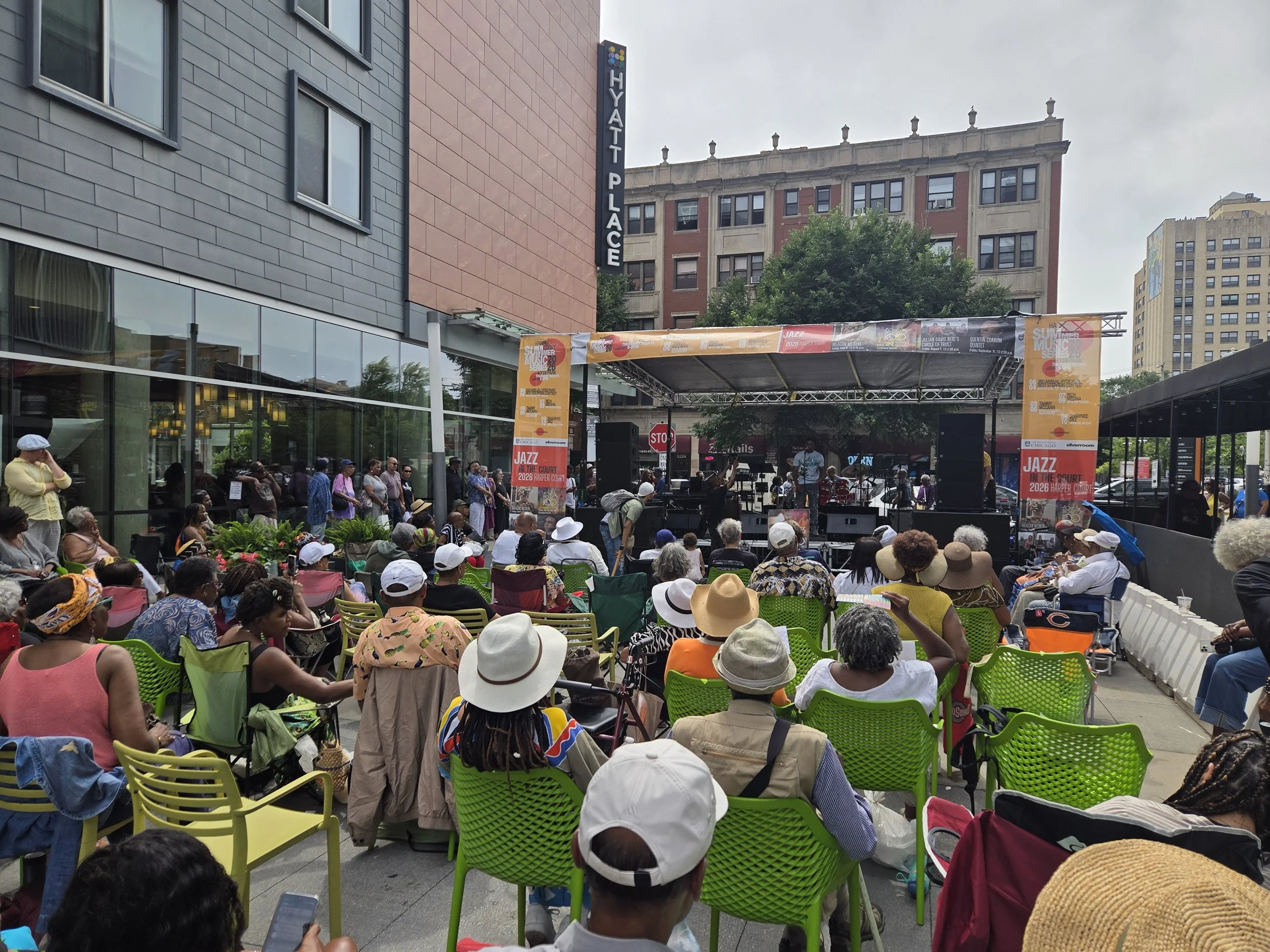
Brown’s proactive, positive mindset – evidenced through his 22 plays/musicals and 13 albums – were recognized, recalled, and rejuvenated on July 10 through “Oscar Brown Jr.: 100 Years of Genius.” HIPsters by the hundreds attended this five-hour celebration held at Harper Court, on the street renamed Honorary Oscar Brown Jr. Way in 2015.
For four-plus decades, Brown brought his humor and desire for social justice to audiences from Chicago, to NBC’s Today show, to performing a one-man show, Oscar Brown Jr. Entertains, in London, to his collaboration with drummer Max Roach on the album We Insist! and then some. These events all happened in the 1960s. Through his creative and humanitarian efforts, Brown’s passion for people and peace inspired HIPness, noted his daughter, Maggie Brown.
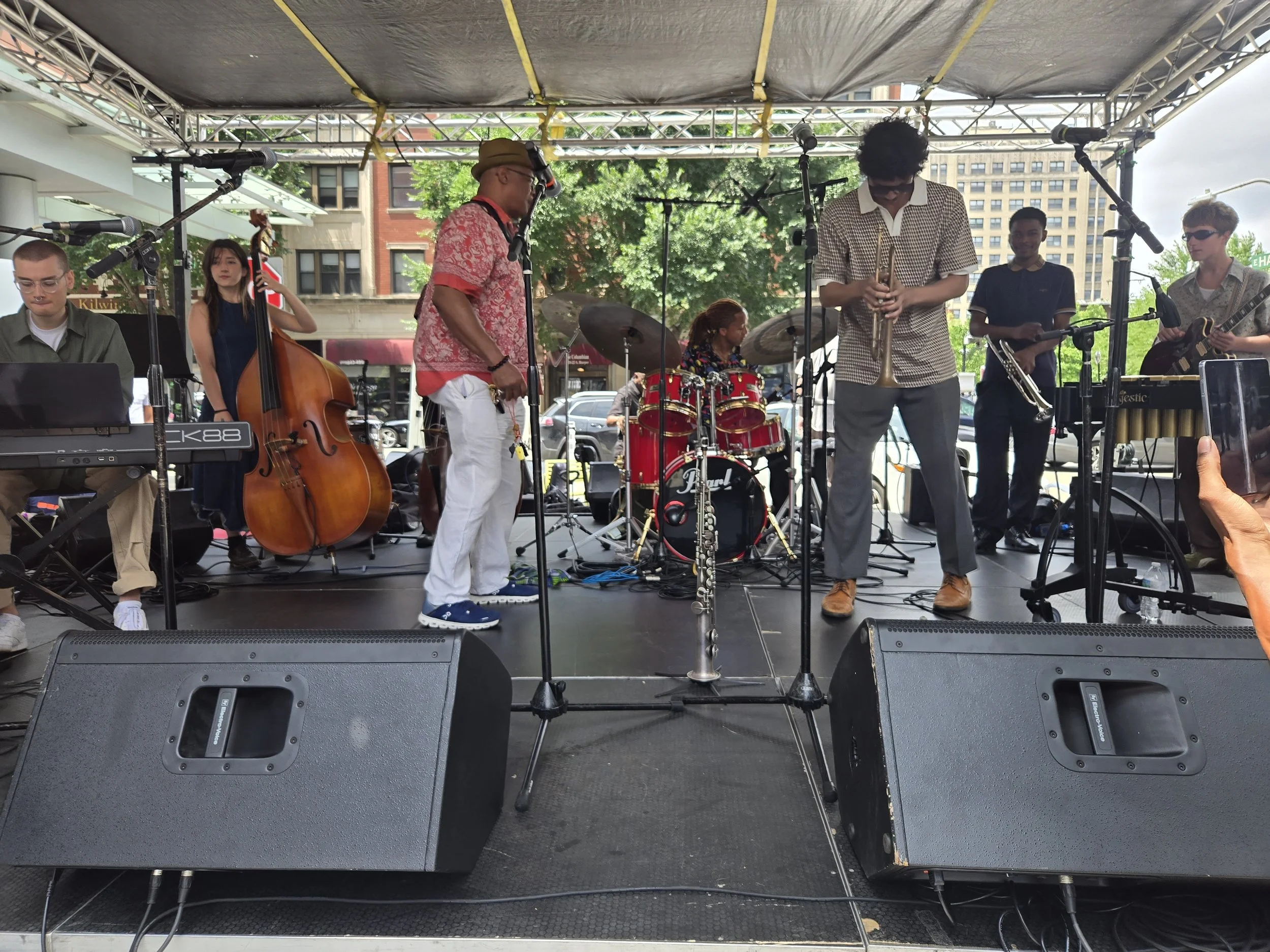
“Everybody wants to be HIP. Everybody needs to be HIP,” said Maggie, the celebration’s host. She, along with her sister, Africa, sang multiple songs from their father’s catalogue. They were supported by pianist Theodis Rodgers Jr., saxophonist James Perkins, bassist Jeremiah Hunt, drummer Charles Heath, and percussionist Tony Carpenter. (Maggie and Africa, also known as 2 Brown Sisters, will open this year’s Chicago Jazz Festival at Millenium Park on September 4. They will also perform at the Englewood Jazz Festival on September 19, and the University of Chicago’s Logan Center on October 10, the day Brown would have celebrated his centennial.)
As each song began, Maggie explained its history. One such story involved saxophonist Cannonball and his brother, cornetist Nat Adderley, who were leading their quintet at the Sutherland Hotel, located on South Drexel. When the brothers played “Work Song,” title track from Nat’s 1960 album, Brown’s attention and imagination were stoked.
“(The brothers) came down after the set, and daddy asked them, ‘Man! What inspired that? Could I write a lyric to it?” Maggie said. “They told him it was inspired by something they saw in Florida when they were pulling up. It was about men working (while engaged in call-and-response singing) on a chain gang.”
Brown’s version would become the lead track on Sin & Soul, his debut album released in 1961. It began:
Breaking up big rocks on the chain gang
Breaking rocks and serving my time
Breaking rocks out here on the chain gang
'Cause I been convicted of crime
Hold it steady right there while I hit it
There, I reckon that ought to get it
Been workin' and workin'
But I still got so terrible long to go.
(By the way, Brown’s reinterpretation would, in later years, be covered by such artists as Nina Simone and Bobby Darin. Also, his lyrics to Mongo Santamaria’s “Afro Blue” were covered by Robert Glasper and Erykah Badu, together, and Abbey Lincoln. Mel Torme and Rickie Lee Jones, separately, recorded Brown’s lyrics to Bobby Timmons’ “Dat Dere.” And Brown also added lyrics to Duke Pearson’s “Jeanine,” and have it recorded by Eddie Jefferson.)
Joy ’66, Brown’s sixth play, attracted sold-out audiences to the Happy Medium, then located on Rush Street. In 1967, Brown decided to spread this positivity by bringing his play to the South side, but he encountered regional reality.
“He could not get the great audiences he had up North,” Maggie said, “because…the headlines were talking about a lot of gang violence and negativity happening in the neighborhoods.”
To solve this toxic situation, Brown decided that a meeting with the Blackstone Rangers would help. He knew that Muhammad Ali, his friend, had attempted something similar.
When intentions met reality, however, the latter prevailed.
“They said they weren’t trying to have an audience with a poet, but eventually he did (meet with them),” Maggie said. “And he told them, ‘Hey, man! You steppin’ on my hustle. What do you want? What do you need? What is the deal?’”
In response, the Rangers requested equitable education, facilities, resources, and attention, so Brown and his wife, Jean Pace, began planning a fundraiser/performance to generate awareness for their pleas.
And, once again, intentions met reality.
“They said, ‘We got talent, too,’” Maggie stated, “and it turned out that (daddy and Jean) ended up doing a show with them instead of just for them.” This musical revue, Opportunity Please Knock, drew more than 8,000 patrons in its first few weeks at Chicago’s Presbyterian Church, 6400 South Kimbark.
Here is an excerpt from the title song:
The older I grow,
The older I grow,
With every tick of the clock,
While I wait for Mister Opportunity to knock,
Opportunity, just knock!
Opportunity, please knock!”
When discussing this production’s impact with interviewer Rick Wojcik in 1996, Brown said, “(This play) really changed my life, basically, because it let me see that there was this enormous talent in the black community. This is where all the dances came from; this is where all the popular music comes from, so I began to really concentrate on that. Opportunity Please Knock ran for a little while, with those kidsbeing on theSmothers Brothers Comedy Hour” (darkjive.com).
In 1967, Brown and Pace also presented Summer In the City at the Harper Theater. This building, now called the Hyde Park Theater, is located across the street from Harper Court. As the band provided support, Maggie and Africa sang the production’s title song, which began:
Summer in the city sure is sweet
Listen to that syncopated city beat
Listen to that soft guitar somewhere
Blowing blue and easy on the warm summer air.
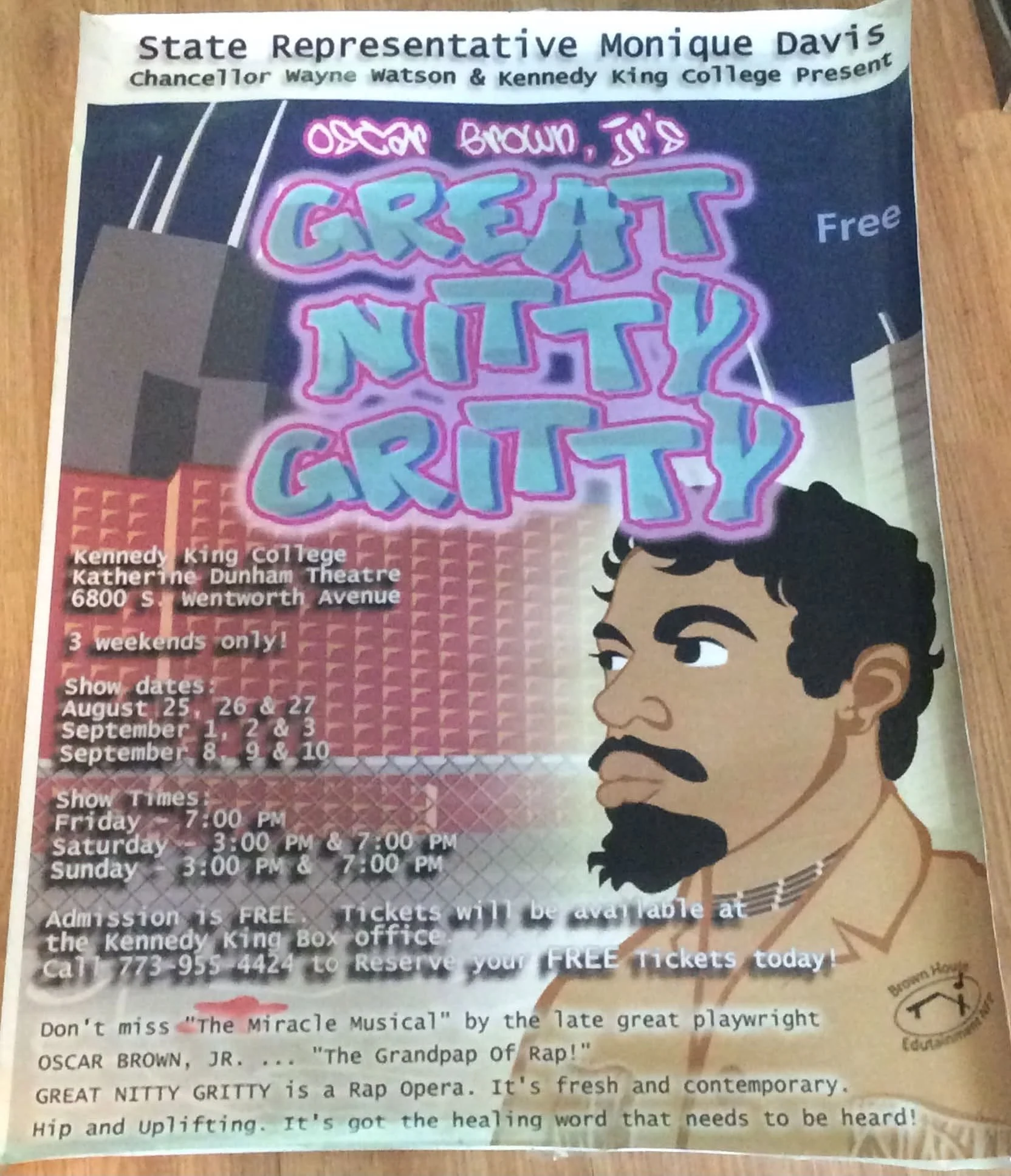
From the early 1970s to 1991, Brown created 15 plays. These efforts included Ignorapa (1971), Maple Leaf (1986), and his finale, It’s About Time. In the early 1980s, Brown composed a musical, Great Nitty Gritty, which featured Chicago youth seeking positive activities. This production debuted in 1982 at Mount Hope Baptist Church, and it also enjoyed runs at the Drury Lane Theater, the South Shore Cultural Center, and various schools, including Kennedy-King College, in 2006.
When expressing his gratitude about this play, Brown wrote: “I love it. It’s a real grassroots project, working with kids. We recruit kids from such places as the Ida B. Wells housing development and find scores of shining talent every year. It’s amazing the talent we have in this city. Amazing” (oscarbrownjr.org).
Harper Court Happenings
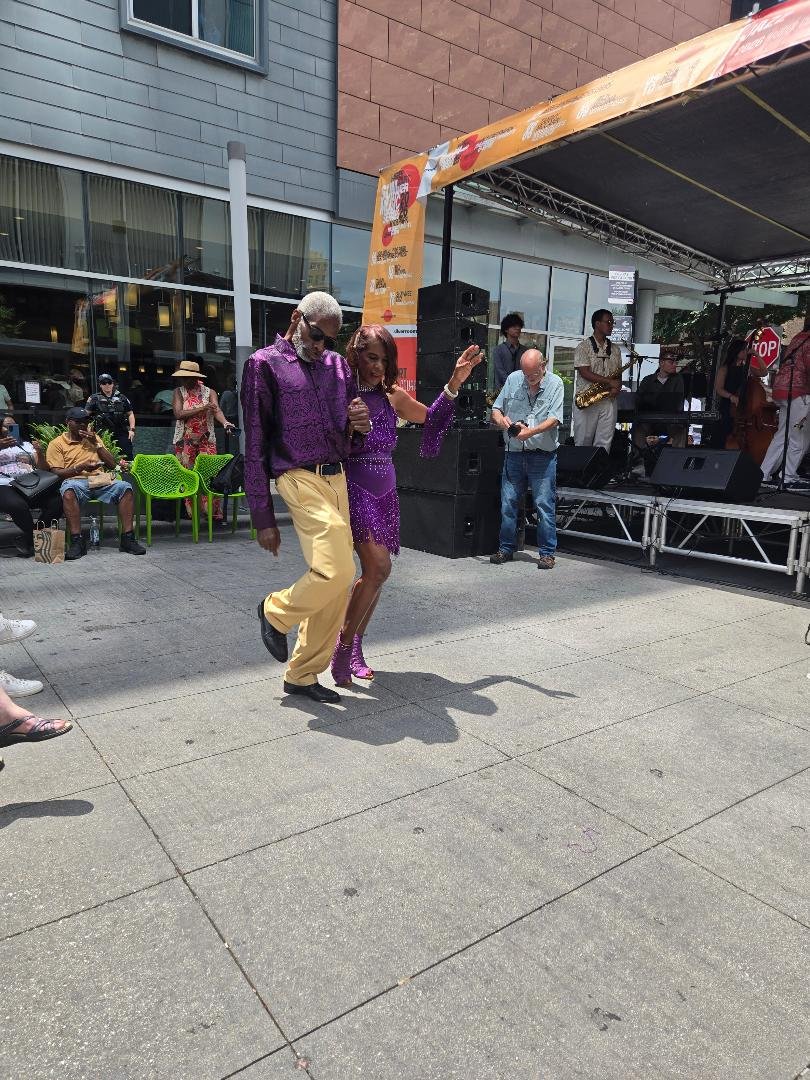
While the 2 Brown Sisters sang, Dawud and Lura, step dance instructors from the Hyde Park School of Dance, slowly set the ground directly in front of the raised stage ablaze. (That area also served as the space for a Brown family photo. Relatives from Edgewater to Albuquerque to California all gathered for the moment.)
Other artists expressing their respect included vocalists Kelli Rich and Amyna Love, saxophonist Dr. Ernest Dawkins and his Youth Jazz Band, harmonica blower Kyle Love, and poet Keith M. Kelley. The latter performed with Brown’s son, Oscar “Bobo” Brown III, (1956-96) in the Funky Wordsmyths, a three-man music and spoken word ensemble.
After the celebration, Kelley expressed his eternal thanks to Brown, Bobo, and Maggie.
“Bobo was my songwriting partner, bandmate, and one of my closest, if not best, friends. I never recovered from the loss of the role he played in my life.
“OBJ was my mentor. Oddly enough, most of his advice was about life — not the craft,” Kelley continued. “I remember he once told me teaching poetry was tantamount to teaching anarchy as far as the powers that be were concerned — and I was teaching it well. Oscar also modeled that being a black poet who wrote about race, class and politics was a noble vocation to adopt in America. (The Browns) were like my family members. Maggie calls me her ‘brother in-lieu’ of Bobo. I miss them both.”
…But He was Cool!
Towards the program’s conclusion, Napoleon Brown, Oscar’s first-born son and manager, endured a medical emergency. As the ambulance’s lights served as a temporary stage backdrop, Maggie soothed everyone’s concerns.
“Last time we had a gig, Napoleon got up to speak, and he got all teary-eyed, which made us get teary-eyed,” she said. “So he figured he would just up the ante. He was much more conscious and made eye contact.”
“Life is gonna life,” Africa added.
What It Is!...was, and always will be…
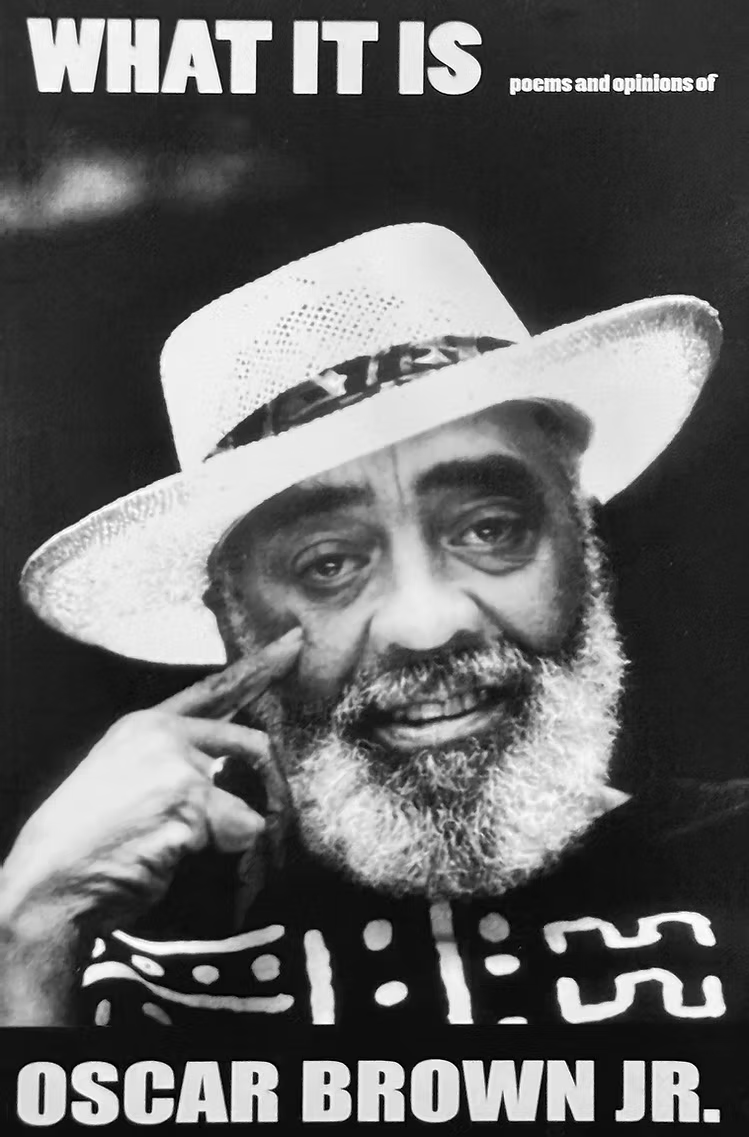
One month before he died, What It Is! Poems and Opinions of Oscar Brown Jr., was published. Arthur Ade Amaker, a City Colleges of Chicago professor, released it through Oyster Knife Press, a company he owned at the time.
When discussing the book, Amaker noted that the cover art came from Live Every Minute, Brown’s album from 1998. Amaker also helped select which works would be included and collaborated with Brown on the Introduction. He also obtained back cover endorsements about the book from poet Sonia Sanchez and Abbey Lincoln.
Amaker, who also advocated for Brown’s induction into the Chicago Literary Hall of Fame in 2025, recalled how their partnership proved enriching.
“It was one of the best experiences I have had as a literary artist. Oscar was such a humble person. He took the whole process very seriously, and it went by smoothly,” Amaker said. “I was happy to have published him. I just wish I had the finances to really push the book to the level that it could have been pushed, but it still worked out. I think Maggie and Africa are doing a fine job of promoting the book and their father’s legacy.
“There are actually thousands of other poems that Oscar wrote that are not even published yet,” Amaker continued. “(This book) is just a fraction. He was really prolific. He was writing almost to the day he died.”
Amaker also discussed “A Column of Birds,” which originally appeared on Live Every Minute. Here is an excerpt:
I saw millions of migrating birds
flying over today
Couldn’t tell which was leading
and showing others the way
as I thought, as I watched them sail by
all in the sky
What a blessing it must be to fly
like a column of birds…
“It’s one of the last pieces in the book. It’s a reflection on the beauty of life, and I didn’t realize until after he passed that it was very fitting, almost like – can I use the word? -- an obituary,” Amaker stated. “It’s basically saying, look at birds flying in the sky. That image really represents God’s grace and essence.
“I had a chance to talk to Oscar at his death bed, and I told him, ‘I’ll see you soon,’ ” Amaker continued, “and that was the first time in my life where I really felt that I would actually see that person again.”